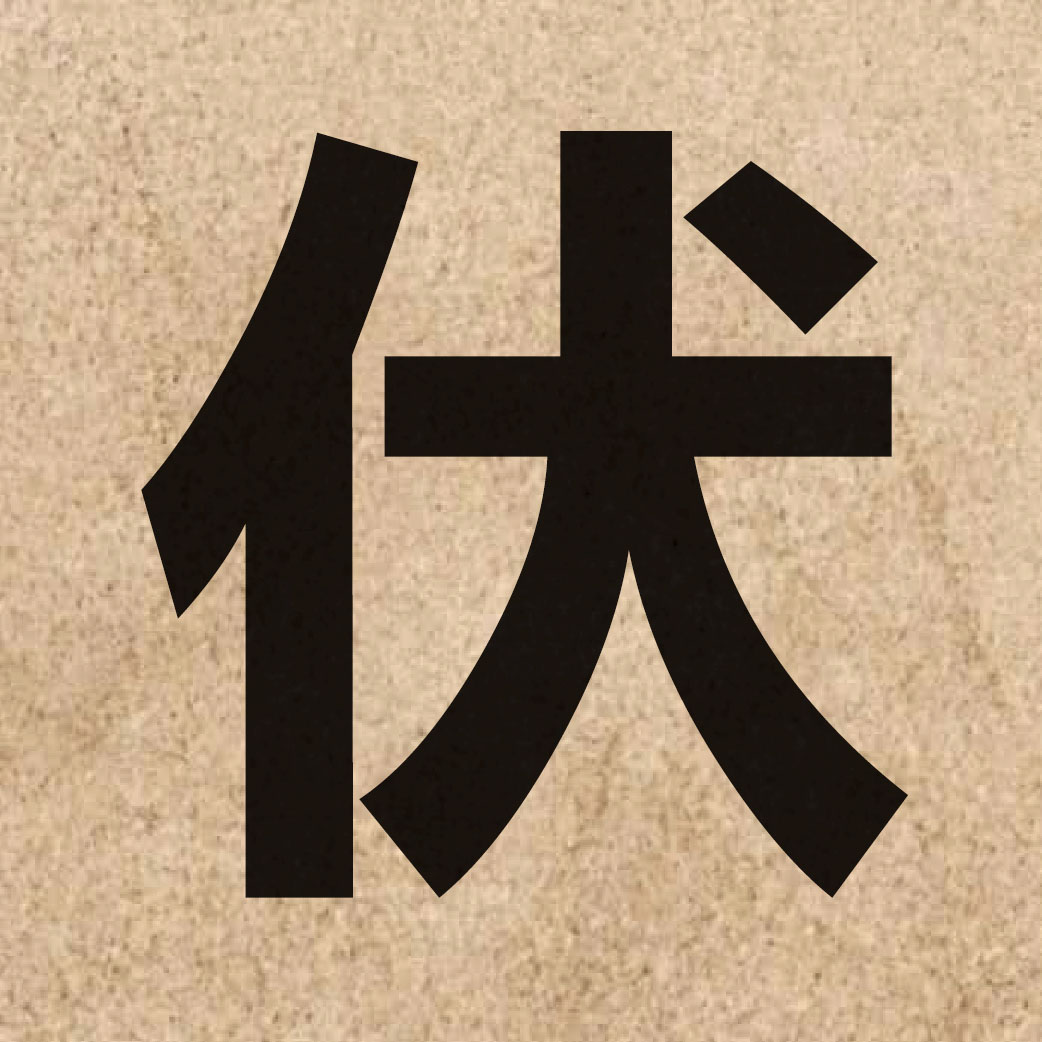
The Chinese character【伏】that we will explain today is a word that describes an action or state. It is mainly used for the following meanings:
To lie prone or hidden. Explanation: (1) Lying prone. For example: “bending over the desk” and “pushing up”. (2) Surrender. Such as: “accept the crime” and “accept the punishment”. (3)Hidden. Such as: “ambush”, “lurking”, “foreshadowing”, “ambush”, “hide during the day and come out at night”. (4) Go lower. Such as: “ups and downs”, “one after another”. (5)Futian: the midsummer days. The thirty days from the third Geng day after the summer solstice are called “Futian”. The first ten days are called the “first dog days”, the middle ten days are called the “middle dog days”, and the last ten days are called the “last dog days”. Together they are called the “three dog days”, which is the hottest period in summer. It is also called “Fu Ri”.
Below is the correct pronunciation of this particular Chinese character.
Mandarin Pinyin of 【伏】:fú
Cantonese Jyutping of 【伏】:buk6/fuk6
Here’s an overview of the essential details about the character 【伏】︰
Here are some situations where you can use【伏】, for example:Describe an action or state , It means primarily to lie prone or to hide. .The nuanced nature of Chinese characters means that some complex or precise interpretations may not be comprehensively conveyed in this space.
【伏】is an individual word that merges with others to generate specific phrases, for example【伏擊、伏地】(Mandarin Pinyin:fú jī 、fú dì/ Cantonese Jyutping:fuk6 gik1 、fuk6 dei6)
This character is written with 6 strokes,It is a more advanced Chinese character that is essential for daily use,The following sentence showcases how this character is used.:
他們在草叢中進行伏擊。
They set up an ambush in the bushes.
May you find joy in studying Chinese and uncover valuable knowledge along the way. Feel free to take a slow and thoughtful look at the resources here.