
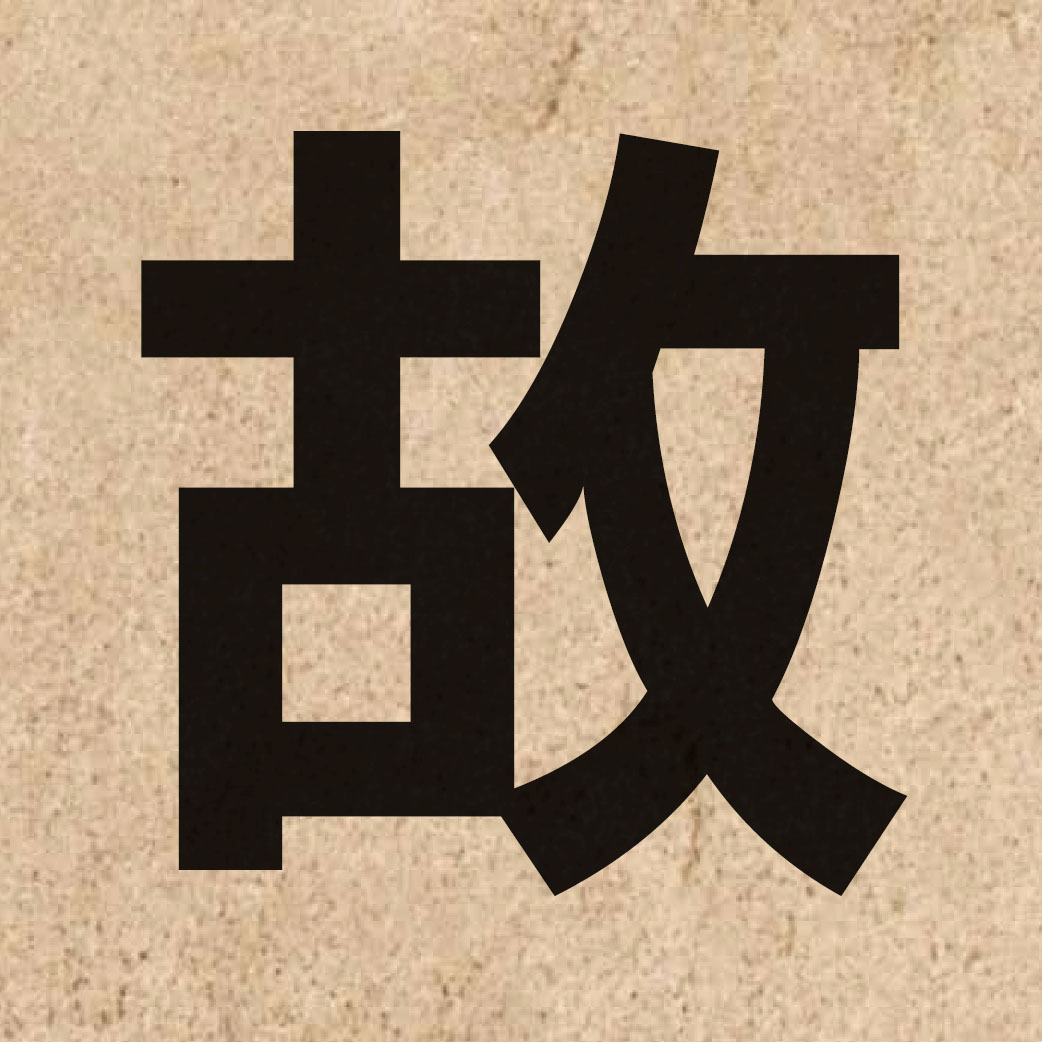
The Chinese word【故】that we will introduce this time is a word that describes action or time. It is mainly used for the following meanings:
Cause or past. Explanation: (1) Friend, old acquaintance. Such as: “old friend”, “related”, “hit it off at first sight”. (2) Original or former. Such as: “hometown”, “old possession”, “story”, “old friend”, “conservative”. (3) Death. Such as: “died of illness”, “died of oneself”, “deceased”. (4) Accidents. Such as: “accident”, “traffic accident”. (5)Reasons. Such as: “reason”, “absent for some reason”, “I don’t know why”. (6) Intentional and deliberate. Such as: “intentionally”, “knowingly and willfully”, “pretending to be calm”. (7) So, therefore. For example: “He studies hard every day, so he gets good grades.”
The pronunciation of this specific Chinese character is given below.
Mandarin Pinyin of 【故】:gù
Cantonese Jyutping of 【故】:gu3/gu2
This section covers the key information related to the character 【故】︰
Here are some situations where you can use【故】, for example:Describing an action or time , It means mainly cause or past .With the depth and complexity of Chinese characters, some refined meanings and specific usages might not be entirely expressed here.
【故】can be used alone, but when combined with other words, it forms richer expressions, such as【故事、故鄉】(Mandarin Pinyin:gù shì 、gù xiāng/ Cantonese Jyutping:gu3 si6 、gu3 hoeng1)
There are exactly 9 strokes in this character,It is a highly common and fundamental Chinese character that must be learned,Below is an example sentence related to this character.:
她的故鄉風景如畫,讓人懷念。
Her hometown is picturesque and nostalgic.
I wish for you to embrace the charm of Chinese and acquire greater knowledge along the way. Take a moment to explore the details provided.
