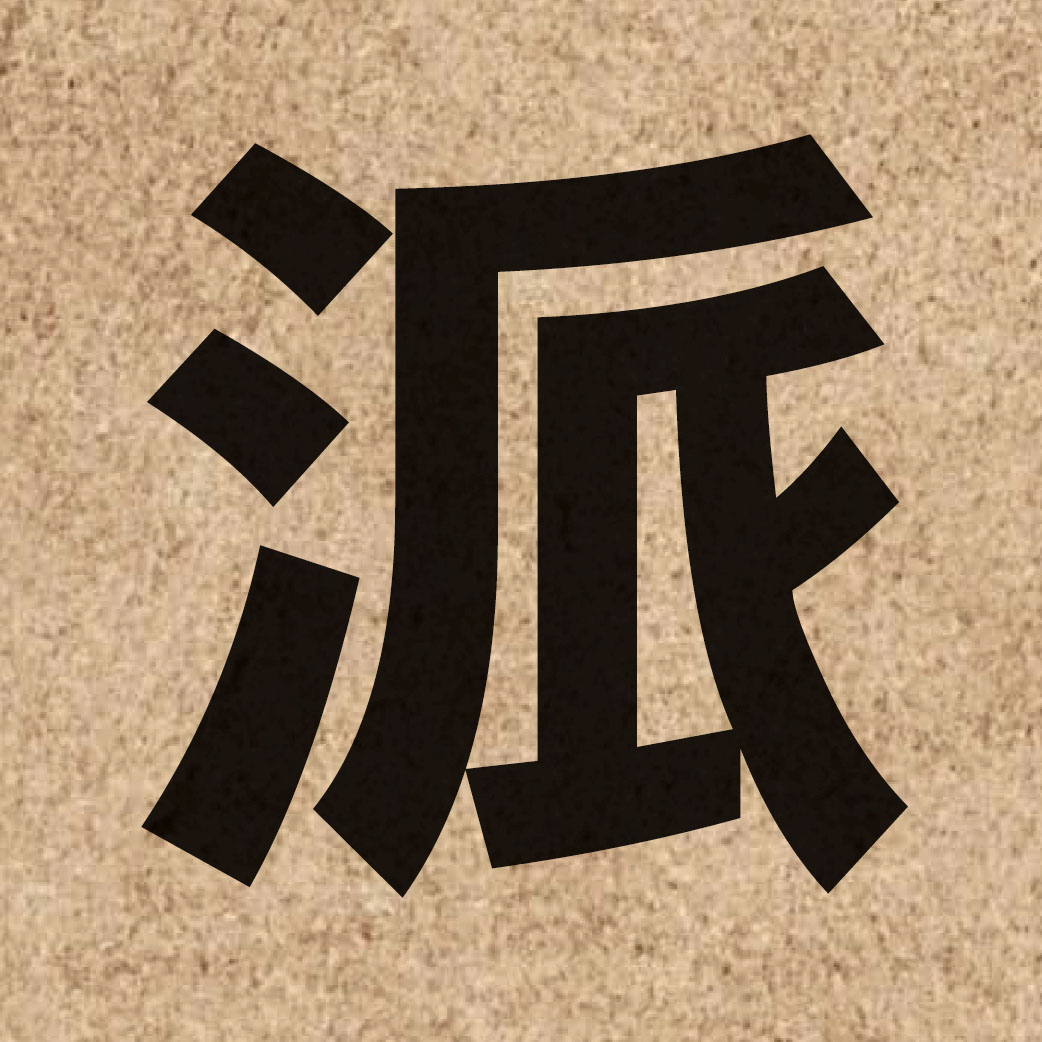
The Chinese word【派】that we will introduce this time is a word that describes a group or classification. It is mainly used for the following meanings:
Organization or school. Explanation: (1) A branch system of people, things or academics. Such as: “faction”, “school”, “stream”, “party”, “poetry school”, and “faction”. (2) Style and momentum. For example: “decent”, “grand”, “style”, and “new style”. (3) Allocation. Such as: “distribution”, “rotation”, “apportionment”. (4) To dispatch or appoint. Such as: “dispatch”, “assignment”, “dispatch troops”. (5) A Western-style baked food. It is the transliteration of the English word pie. Such as: “Apple Pie”, “Lemon Pie”, “Mille-Layer Pie”, “Fruit Pie”. (6) Arrangement. For example: “come in handy.” (7) Police station: A branch of a police station within its jurisdiction, responsible for assisting police duties and providing food and lodging for police personnel. For example: “If you see any suspicious person, please report it to the nearest police station.” (8) Quantifier. Used to calculate faction units. For example: “The styles of these two schools of painters are very different.”
The pronunciation of this specific Chinese character is given below.
Mandarin Pinyin of 【派】:pài
Cantonese Jyutping of 【派】:paai3
This introduces some basic knowledge regarding the Chinese character 【派】︰
Here are some situations where you can use【派】, for example:Describing a group or category , It means mainly an organization or school.As Chinese characters hold complex and sophisticated meanings, certain aspects may be too detailed to fully articulate in this explanation.
【派】serves as a standalone word but gains depth when partnered with others to form detailed expressions, like【流派、學派】(Mandarin Pinyin:liú pài 、xué pài/ Cantonese Jyutping:lau4 paai3 、hok6 paai3)
The total stroke number of this character is 9 ,It is a highly common and fundamental Chinese character that must be learned,Below is an example sentence related to this character.:
他屬於傳統派,偏愛經典藝術。
He is a traditionalist who prefers classical art.
Hoping that you’ll be captivated by Chinese and gain valuable knowledge here. There’s plenty for you to explore—take your time!