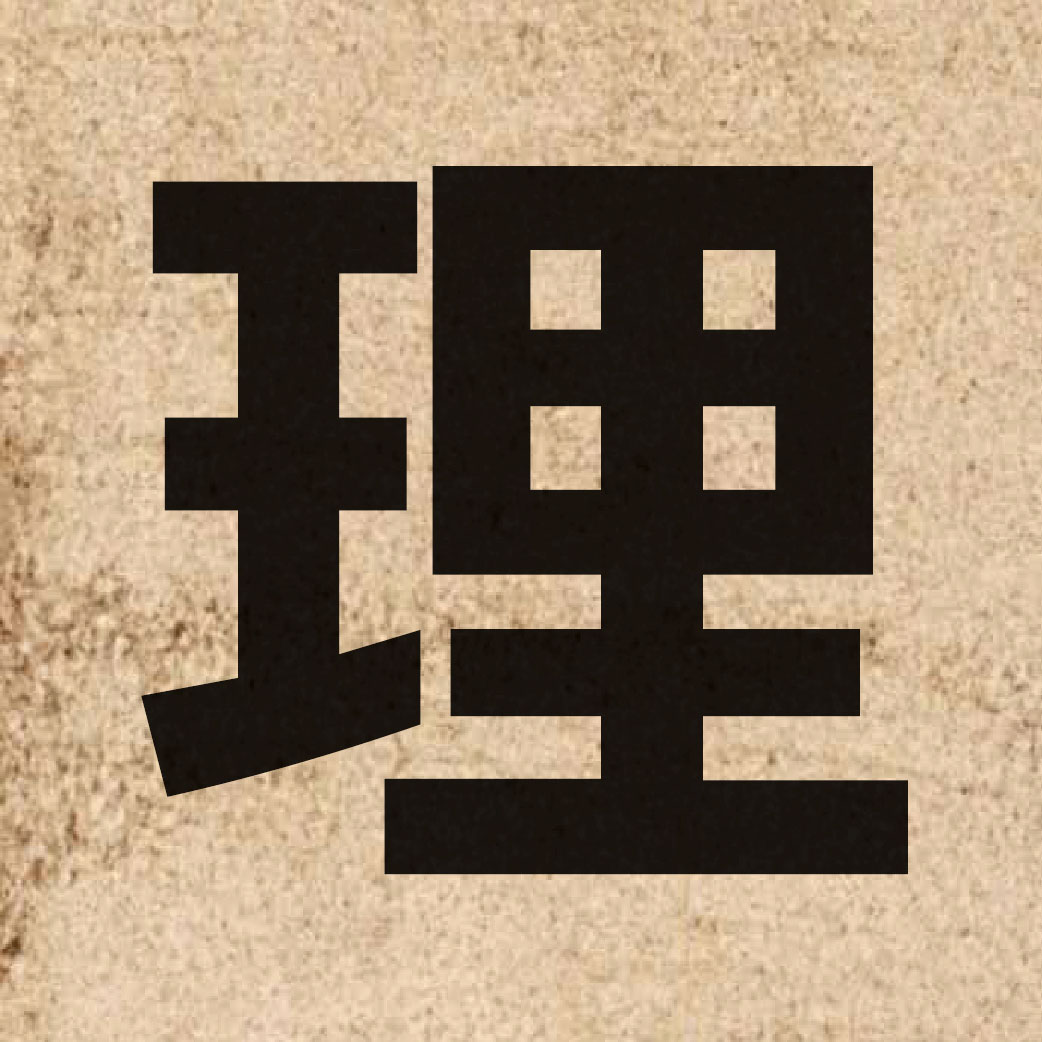
The Chinese character【理】that we will explain today is a word that describes thinking or action. It is mainly used for the following meanings:
Reason or management. Explanation: (1) The principles and laws of things. Such as: “principle”, “reason”, “axiom”, “righteousness”, and “truth”. (2) Texture and organization of matter. Such as: “texture”, “wood texture”, “grain”. (3) To handle and deal with matters. Such as: “handle”, “govern”, “handle”, “act as an agent”. (4) To repair or make things neat and tidy. Such as: “tidy up”, “manage the house”, “cut hair”. (5) An attitude that expresses opinions or reflects on the words and actions of others. For example: “pay attention to”, “ignore”, “ignore you!” (6) Order and level. For example: “well-organized”, “This letter is well-written.” (7) Review, familiarize yourself with. For example: “If you understand the lessons well, you won’t be familiar with the book if you don’t understand it well.” (8) Natural sciences. For example: “Physics and Chemistry”, “Science and Engineering”, “Science”.
The pronunciation of this specific Chinese character is given below.
Mandarin Pinyin of 【理】:lǐ
Cantonese Jyutping of 【理】:lei5
Below, you’ll find general facts about the Chinese character 【理】︰
Here are some situations where you can use【理】, for example:Describing thoughts or actions , It means mainly reason or management .The richness of Chinese characters allows for a wide range of meanings, some of which may be too complex to be fully explained here.
【理】is a word that, when joined with additional words, constructs more precise phrases, like【理論、管理】(Mandarin Pinyin:lǐ lùn 、guǎn lǐ/ Cantonese Jyutping:lei5 leon6 、gun2 lei5)
To form this character, you need 11 strokes,It is a highly common and fundamental Chinese character that must be learned,Below, you’ll find a sentence connected to this character.:
他正在學習經濟管理理論。
He is studying economic management theory.
Wishing you a wonderful journey in embracing Chinese and expanding your knowledge. There’s more information for you to explore leisurely.