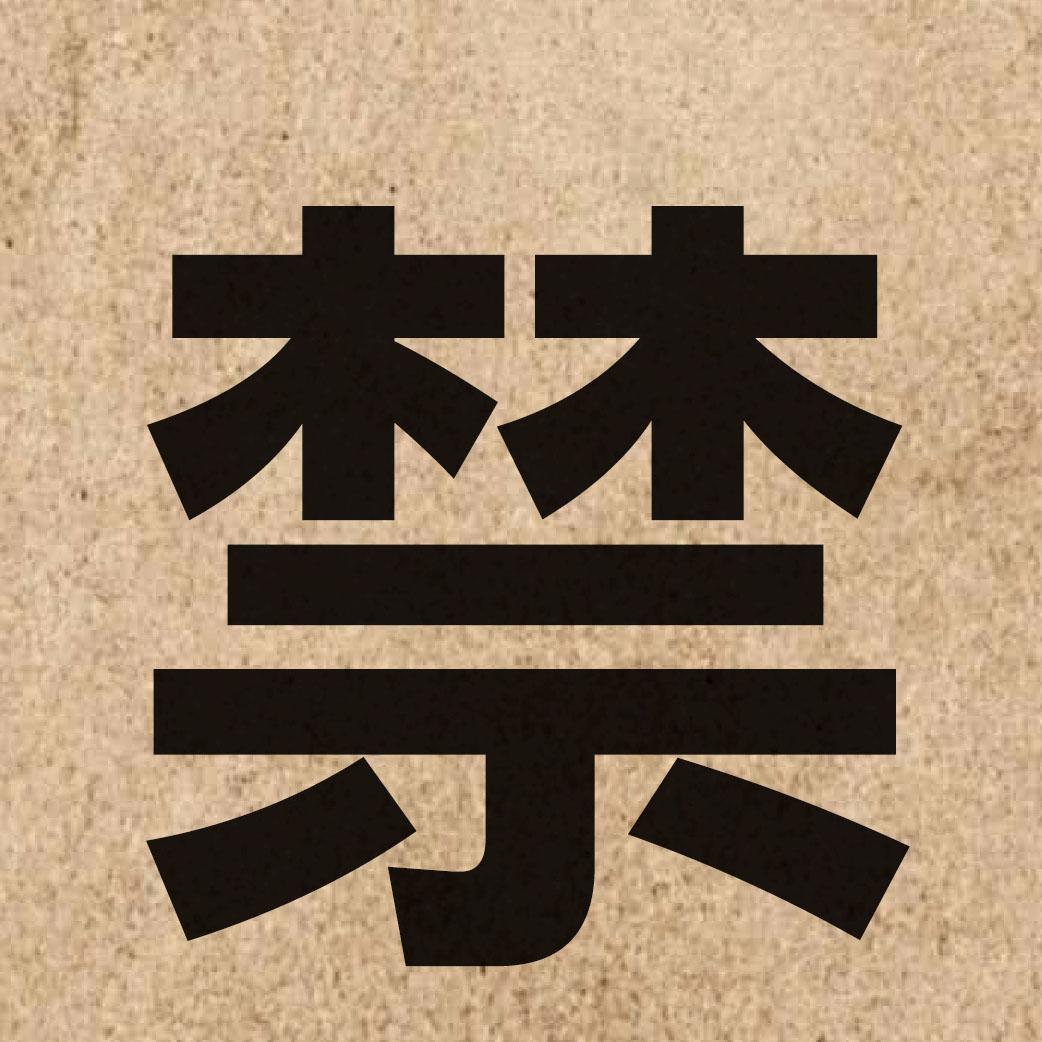
The Chinese character【禁】that we will talk about today is a word that describes action or restriction. It is mainly used for the following meanings:
Prohibit or restrict. Explanation: 1. (1) To stop. For example: “ban”, “banned books”, “prohibition”, “no smoking”, “no littering”. (2) Detention and seizure. Such as: “detention”, “confinement”, “imprisonment”. (3) Something to be cautious about. Such as: “temporary prohibitions”, “ask about prohibitions when entering a country”, “no taboos”. (4) Contains restrictive provisions or regulations. For example: “Access ban”, “Alcohol ban”. (5) In ancient times, the place where the emperor lived. For example: “Forbidden Palace”, “Forbidden Army”, “Forbidden Guard”, “Forbidden City”. 2. (1) To undertake or endure. For example: “can withstand”, “cannot withstand”, “fragile”, “she can’t withstand the wind and sun.” (2) Refers to the durability of something. Such as: “These shoes are forbidden!”
This section provides the pronunciation of the Chinese character.
Mandarin Pinyin of 【禁】:jìn
Cantonese Jyutping of 【禁】:gam3
Below, you’ll find general facts about the Chinese character 【禁】︰
Here are some situations where you can use【禁】, for example:Describe the action or restriction , It means mainly to prohibit or restrict .Given the broad interpretative scope of Chinese characters, certain deeper meanings and unique applications may be beyond this explanation.
【禁】is a word that, when joined with additional words, constructs more precise phrases, like【禁止、禁忌】(Mandarin Pinyin:jìn zhǐ 、jìn jì/ Cantonese Jyutping:gam3 zi2 、gam3 gei6)
To form this character, you need 13 strokes,It is a more advanced Chinese character that is essential for daily use,Below, you’ll find a sentence connected to this character.:
校園內禁止吸煙以保持環境清潔。
Smoking is prohibited on campus to keep the environment clean.
I hope you enjoy the richness of the Chinese language and gain new insights while browsing. Take your time to explore the details.