
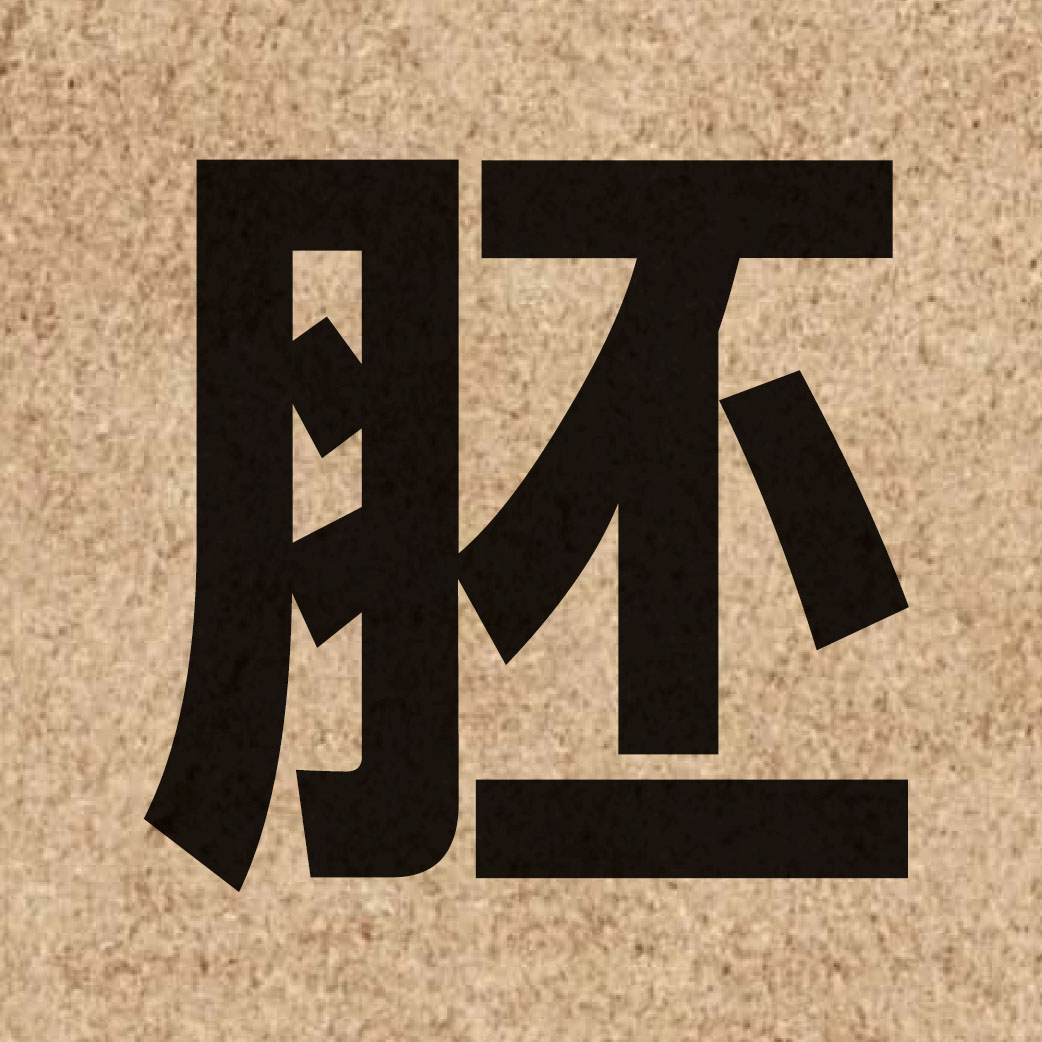
The Chinese word【胚】to be introduced this time is a word that describes organisms or the beginning, and is mainly used for the following meanings:
Embryo or root. Explanation: (1) An organism in the early stages of development of plants and animals. For example, when a bird egg is fertilized, the small dots on the yolk are called “embryos”; the kernel in the drupe of a plant is also called “embryos”. Such as: “embryo”, “germ”, “embryo sac”, “ovule”. (2) An object that has a rough outline but is not yet completed. Such as: “porcelain embryo”, “ceramic embryo”, “brick embryo”.
The pronunciation of this specific Chinese character is given below.
Mandarin Pinyin of 【胚】:pēi
Cantonese Jyutping of 【胚】:pui1
Below, I will share fundamental aspects of the meaning and usage of the character 【胚】︰
Here are some situations where you can use【胚】, for example:Describe the creature or the original , It means mainly embryo or root .Given the broad interpretative scope of Chinese characters, certain deeper meanings and unique applications may be beyond this explanation.
【胚】is a simple word when used alone, but its meaning broadens when combined with others to form intricate phrases, like【胚胎、芽胚】(Mandarin Pinyin:pēi tāi 、yá pēi/ Cantonese Jyutping:pui1 toi1 、ngaa4 pui1)
To complete this character, you need 9 strokes,It is a Chinese character that, once mastered, allows for a deeper understanding and more diverse expression in communication,The sentence below shows how this character appears in written language.:
科學家正在研究植物的胚胎發育。
Scientists are studying embryonic development in plants.
I hope you enjoy the richness of the Chinese language and gain new insights while browsing. Take your time to explore the details.
