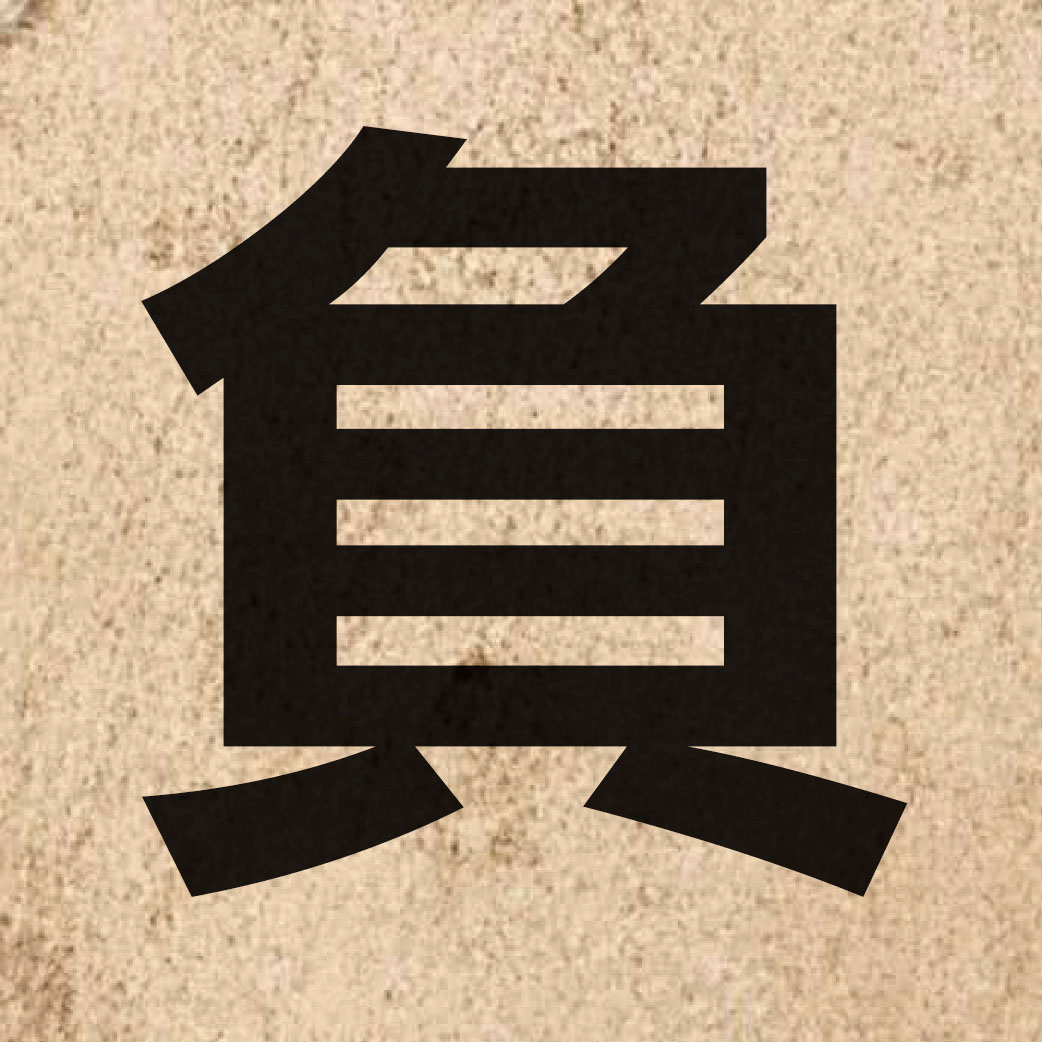
The Chinese word【負】that we will introduce this time is a word that describes action or responsibility. It is mainly used for the following meanings:
To bear or carry. Explanation: (1) To carry something on one’s shoulders. For example: “carrying firewood” and “carrying thorns to ask for forgiveness”. (2) To betray or violate. Such as: “let down”, “ungrateful”. (3) The opposite of. For example: “negative charge”, “negative pole”, “negative number”. (4) Rely on. For example: “arrogant”. (5) To bear or undertake a burden. Such as: “shouldering a heavy responsibility”. (6) Lean against or with your back to. For example: “Facing the sea and the mountains”. (7) Suffer. For example: “injured”. (8) Enjoy. For example: “renowned”. (9) Debt or arrears. For example: “liabilities”. (10) Failure. For example: “The winner is clear”, “The winner is not clear”.
You’ll find the pronunciation for this Chinese character here.
Mandarin Pinyin of 【負】:fù
Cantonese Jyutping of 【負】:fu6
Below, you’ll find general facts about the Chinese character 【負】︰
Here are some situations where you can use【負】, for example:Describe an action or responsibility , It means mainly to bear or to carry .Because of the extensive meanings of Chinese characters, some intricate details and specialized uses might not be fully presented here.
【負】is a word that, when joined with additional words, constructs more precise phrases, like【負責、負擔】(Mandarin Pinyin:fù zé 、fù dān/ Cantonese Jyutping:fu6 zaak3 、fu6 daam1)
To form this character, you need 9 strokes,It is a highly common and fundamental Chinese character that must be learned,The sentence below shows how this character appears in written language.:
他願意負責這項艱難的任務。
He is willing to take on this difficult task.
Wishing you a wonderful learning experience with Chinese, where you can expand your understanding. There’s plenty to discover, so browse freely.