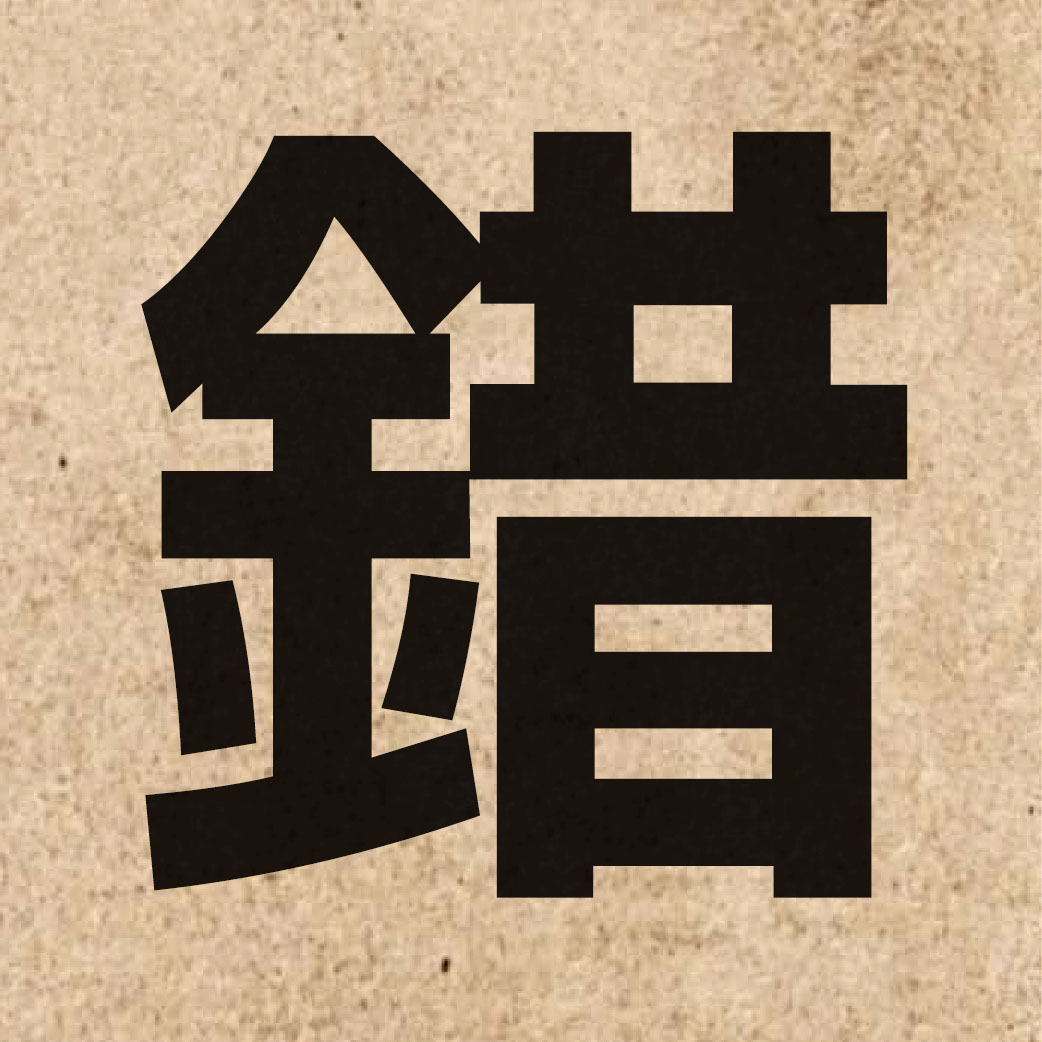
The Chinese character【錯】(wrong) that we will explain today is a word that describes a state or event. It is mainly used for the following meanings:
Error or interlacing. Explanation: (1) Mistake, wrong. For example: “typo”, “error”, “correction”. (2) Bad. For example: “They have a good relationship.” (3) Chaotic. Such as: “confusion”, “scattered”. (4) Intermingling. Such as: “interlaced canine teeth” and “tangled roots”. (5) Lose. For example: “Missed opportunity”. (6) Whetstone. For example: “One can learn from others’ mistakes.”
You’ll find the pronunciation for this Chinese character here.
Mandarin Pinyin of 【錯】:cuò
Cantonese Jyutping of 【錯】:co3
This section covers the key information related to the character 【錯】︰
Here are some situations where you can use【錯】, for example:Describes a state or event , It means mainly error or staggered .The richness and complexity of Chinese characters enable various interpretations, some of which may exceed what is presented here.
【錯】can be used alone, but when combined with other words, it forms richer expressions, such as【錯誤、交錯】(Mandarin Pinyin:cuò wù 、jiāo cuò/ Cantonese Jyutping:co3 ng6 、gaau1 co3)
There are exactly 16 strokes in this character,It is a highly common and fundamental Chinese character that must be learned,The following sentence showcases how this character is used.:
他在報告中犯了一個小錯誤。
He made a small mistake in his report.
I trust you’ll have a rewarding experience exploring Chinese and expanding your insights. Take your time to browse through the information provided.