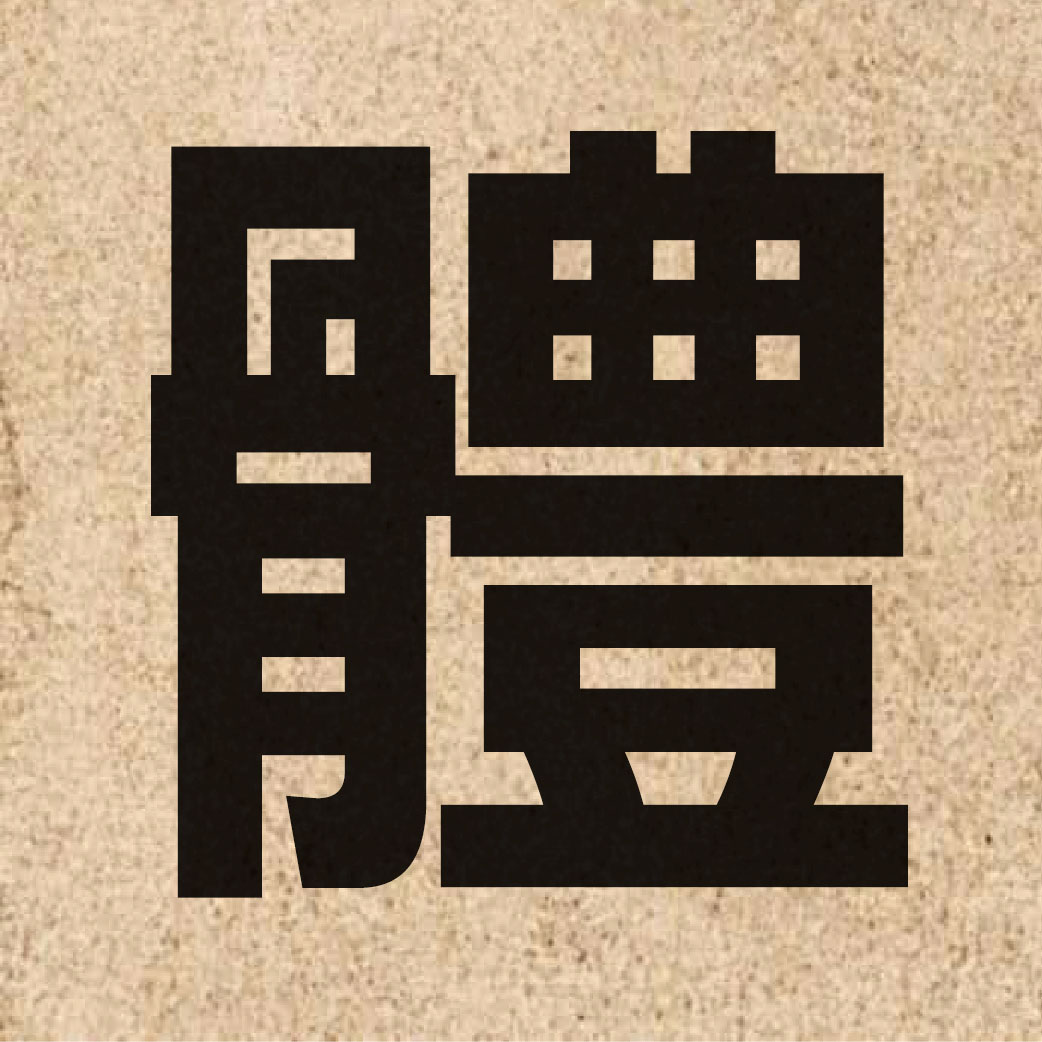
The Chinese character【體】is a word that describes structure or health, and is mainly used for the following meanings:
body or object. Explanation: (1) The whole body of a human or other animal. Such as: “body”, “human body”, “physique”, “physical strength”. (2) A part of the body. Such as: “limbs”, “four limbs are not active”, “five limbs prostrate themselves on the ground”. (3) Personally. Such as: “experience”, “understand”, “perceive”. (4) The essential form or main part of a thing. For example: “solid”, “liquid”, “subject”, “object”. (5) Put yourself in other people’s shoes and be considerate of them. Such as: “considerate”, “thoughtful”, “sympathetic”. (6) A certain system, genre or format. Such as: “literary style”, “political system”, “system”, and “system”. (7) The form of written text. For example: “font”, “cursive”, “Yan style”. (8) In mathematics, it refers to the shape of a three-dimensional object. For example: “cube”, “rectangular parallelepiped”, “cylinder”.
Below, you can see how this Chinese character is pronounced.
Mandarin Pinyin of 【體】:tǐ
Cantonese Jyutping of 【體】:tai2
This section covers the key information related to the character 【體】︰
Here are some situations where you can use【體】, for example:Describe structure or health , It means primarily a body or an object .The nuanced nature of Chinese characters means that some complex or precise interpretations may not be comprehensively conveyed in this space.
【體】can be used alone, but when combined with other words, it forms richer expressions, such as【身體、物體】(Mandarin Pinyin:shēn tǐ 、wù tǐ/ Cantonese Jyutping:san1 tai2 、mat6 tai2)
There are exactly 23 strokes in this character,It is a highly common and fundamental Chinese character that must be learned,Here’s a practical example using this character.:
健康的身體是幸福的基礎。
A healthy body is the foundation of happiness.
May you find joy in studying Chinese and uncover valuable knowledge along the way. Feel free to take a slow and thoughtful look at the resources here.