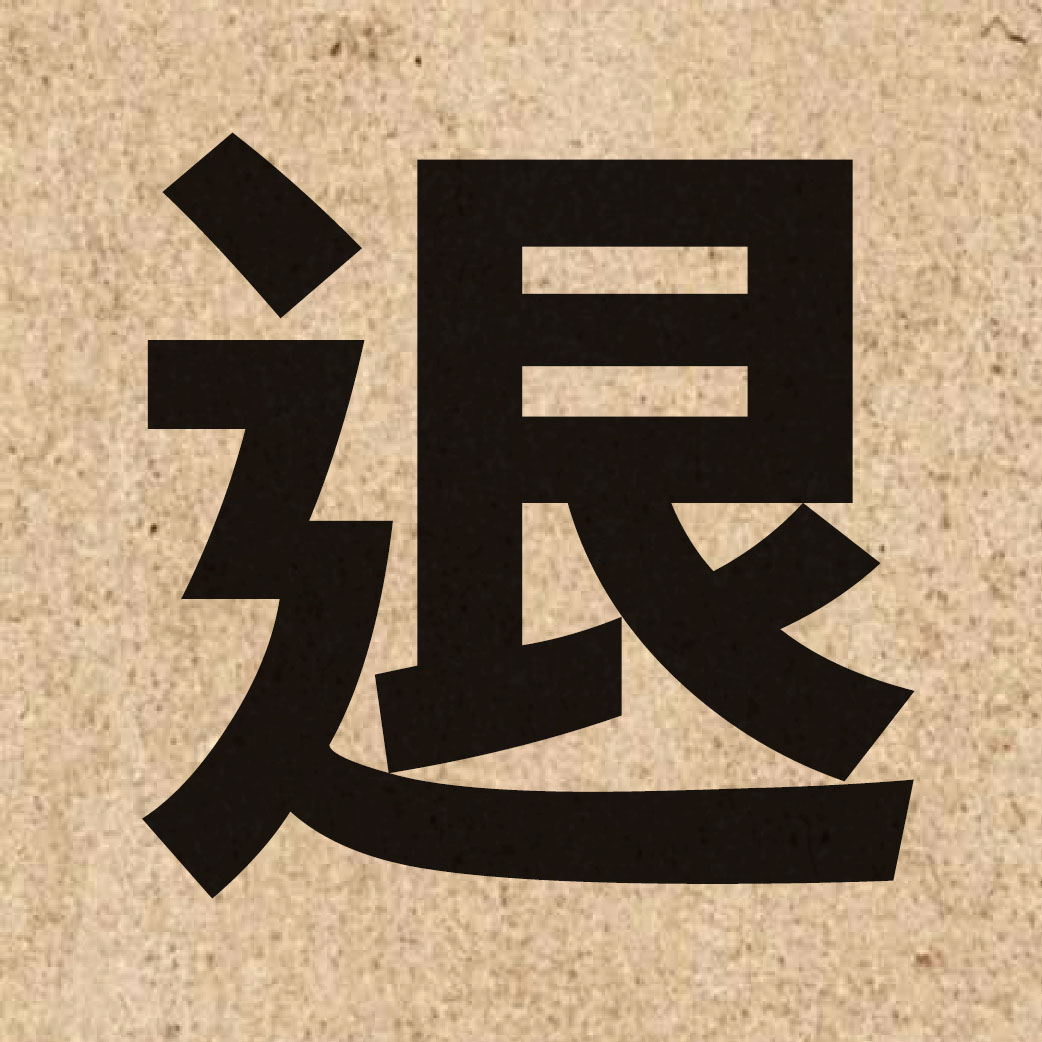
The Chinese character【退】that we will explain today is a word that describes an action or a state. It is mainly used for the following meanings:
Back off or exit. Explanation: (1) To remove dirt with water. For example: “washing clothes”, “taking a bath”, “washing hair”, and “washing dishes”. (2)Removal. Such as: “to clear”, “to wash away sins”, “to clear up injustice”. (3) Empty. Such as: “poor as a beggar”, “penniless”. (4) To mend one’s ways and turn to the good. Such as: “turn over a new leaf.” (5) Utensils that can be washed. Such as: “brush washer”. (6) Develop and fix the photographed film. For example: “Develop photos”.
The pronunciation of this specific Chinese character is given below.
Mandarin Pinyin of 【退】:tuì
Cantonese Jyutping of 【退】:teoi3
This section presents general background information on the Chinese character 【退】︰
Here are some situations where you can use【退】, for example:Describe an action or state , It means mainly to retreat or withdraw .As Chinese characters hold complex and sophisticated meanings, certain aspects may be too detailed to fully articulate in this explanation.
【退】exists independently, yet its interaction with other words enriches expressions, such as【退步、退縮】(Mandarin Pinyin:tuì bù 、tuì suō/ Cantonese Jyutping:teoi3 bou6 、teoi3 suk1)
It takes 9 strokes to write this character,It is a more advanced Chinese character that is essential for daily use,The following sentence showcases how this character is used.:
他因壓力過大而選擇退縮。
He chose to back off due to excessive pressure.
Hoping that you’ll be captivated by Chinese and gain valuable knowledge here. There’s plenty for you to explore—take your time!