
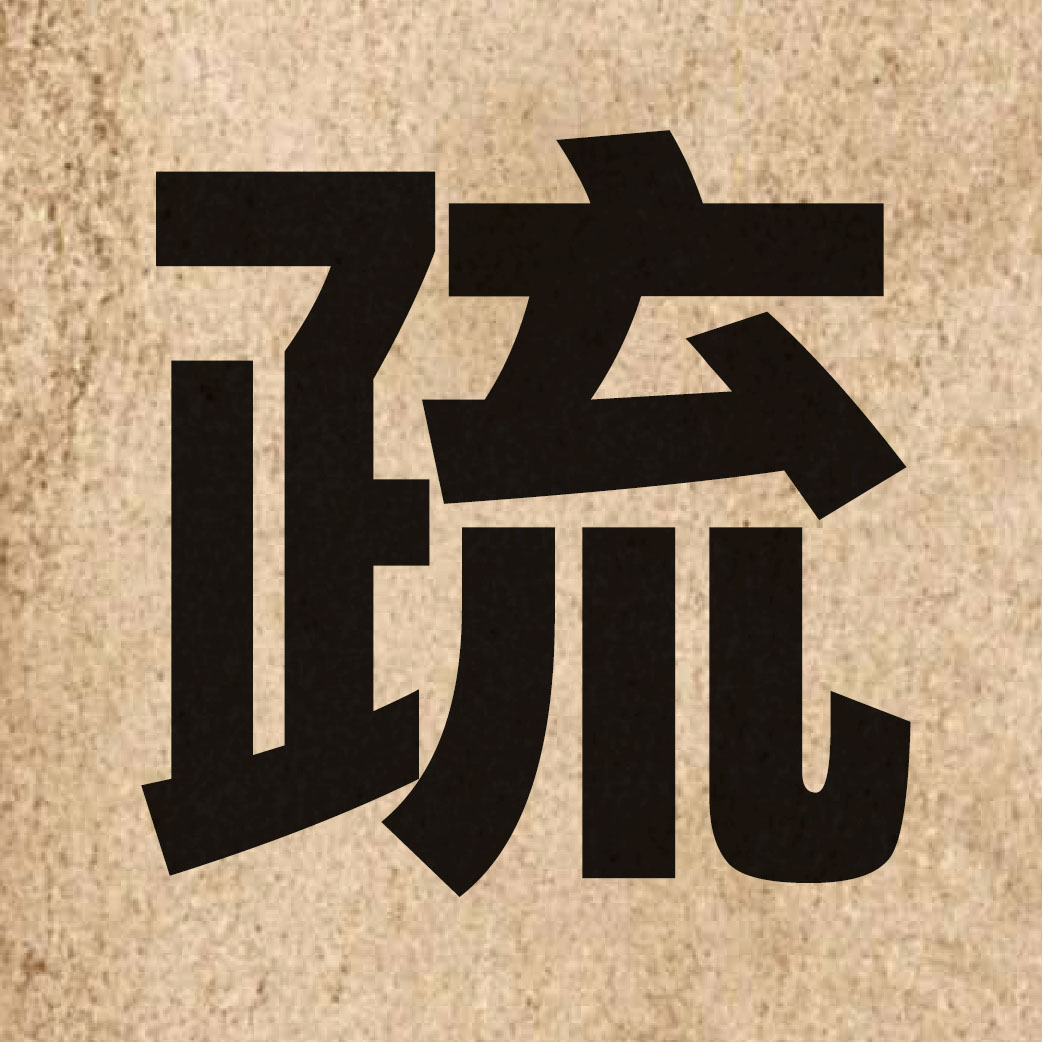
The Chinese character【疏】is a word that describes a state or action, and is mainly used for the following meanings:
Sparse or unblocked. Explanation: (1) To make it smooth. Such as: “dredge”, “relieve”, “guide”. (2) Unfamiliarity and lack of closeness. Such as: “closeness”, “estrangement”, “sense of alienation”, “strangeness of people and places”. (3) Rare and incomplete. Such as: “sparse”, “a single hole in a perfect plan”, “scattered and sparse”. (4) Ignore or fail to pay attention. Such as: “negligence”, “negligence in teaching”, “negligence in prevention”. (5) Dispersion. Such as: “evacuate”, “give money out of kindness”. (6) Empty and unreal. Such as: “empty”, “little talent and shallow learning”. (7) A report submitted by an official to the emperor in ancient times. Such as: “submitting a memorial”, “submitting a memorial”, and “submitting a memorial”. (8) Texts that explain the meaning of ancient texts. Such as: “Annotations and Commentaries”.
Here is the phonetic guide for pronouncing this Chinese character.
Mandarin Pinyin of 【疏】:shū
Cantonese Jyutping of 【疏】:so1
Here is some fundamental information about the character 【疏】︰
Here are some situations where you can use【疏】, for example:Describe a state or action , It means mainly to sparse or unblock .Given the broad interpretative scope of Chinese characters, certain deeper meanings and unique applications may be beyond this explanation.
【疏】is a word that can combine with others to create more detailed terms or phrases, such as【稀疏、疏通】(Mandarin Pinyin:xī shū 、shū tōng/ Cantonese Jyutping:hei1 so1 、so1 tung1)
This character has a total of 11 strokes,It is a more advanced Chinese character that is essential for daily use,Here’s an example showing how this character can be effectively used.:
他正在疏通下水道的堵塞部分。
He is unclogging the drain.
I hope you enjoy the richness of the Chinese language and gain new insights while browsing. Take your time to explore the details.
