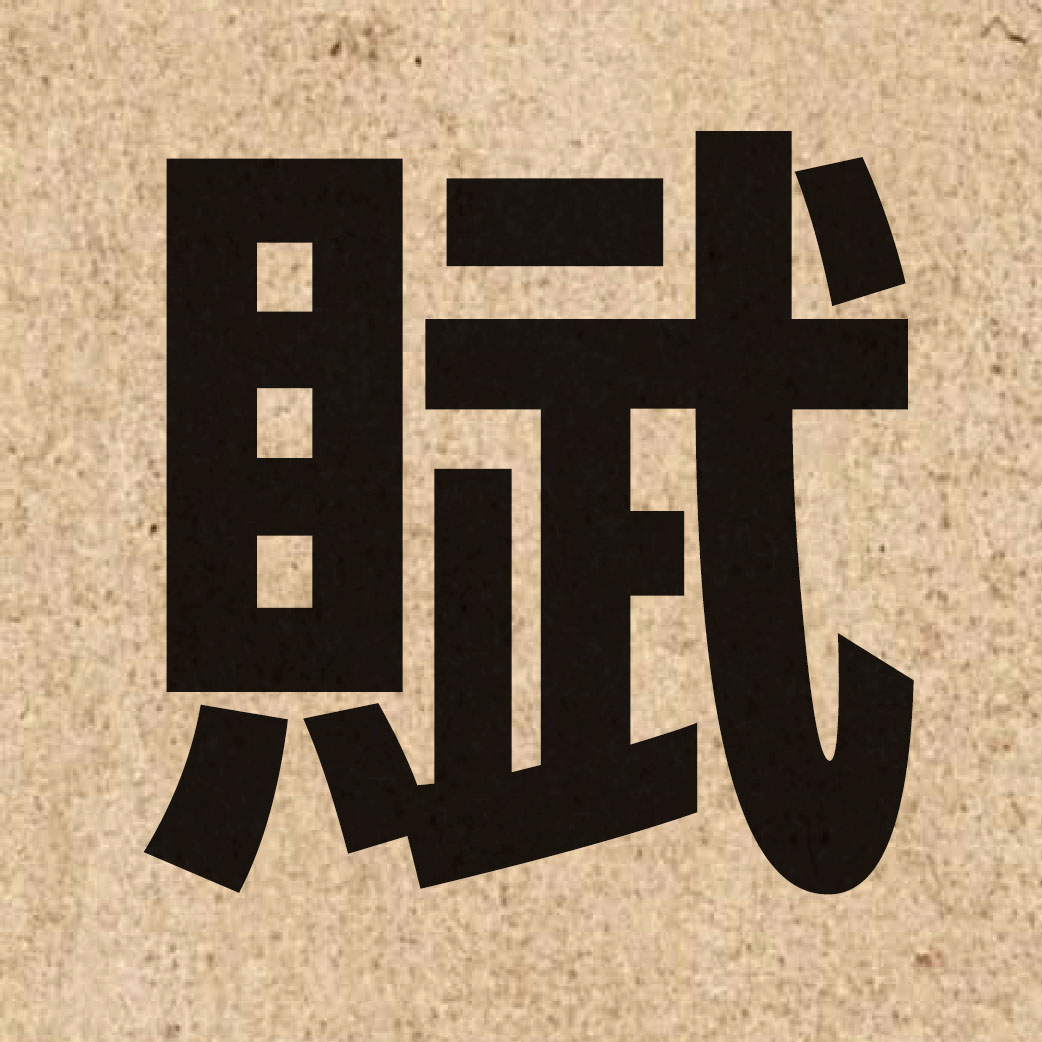
The Chinese character【賦】that we will talk about today is a word that describes action or literature. It is mainly used for the following meanings:
Give or poetry. Explanation: (1) To give or confer. Such as: “endowed”, “gifted”, “natural human rights”. (2)Taxes. For example: “taxes” and “land taxes”. (3) Reciting and writing. For example: “write a poem”. (4) A style of writing used for narrating stories or describing scenes. A rhymed verse between poetry and prose. For example: “Han Fu” and “Ci Fu”. (5) One of the six principles of the Book of Songs. Refers to a descriptive method that directly presents a narrative. For example: “Fu Bi Xing”.
You’ll find the pronunciation for this Chinese character here.
Mandarin Pinyin of 【賦】:fù
Cantonese Jyutping of 【賦】:fu3
This section presents general background information on the Chinese character 【賦】︰
Here are some situations where you can use【賦】, for example:Describing action or literature , It means mainly to give or poetically .The vast and layered meanings of Chinese characters can involve refined details and particular applications that may not be completely conveyed here.
【賦】exists independently, yet its interaction with other words enriches expressions, such as【賦予、詩賦】(Mandarin Pinyin:fù yǔ 、shī fù/ Cantonese Jyutping:fu3 jyu5 、si1 fu3)
It takes 15 strokes to write this character,It is a more advanced Chinese character that is essential for daily use,Below is a sample sentence featuring this character in real usage.:
詩人創作了一篇精彩的詩賦。
The poet created a wonderful poem.
I trust you’ll enjoy immersing yourself in the world of Chinese and discovering more insights. You can browse through the additional details at your own speed.