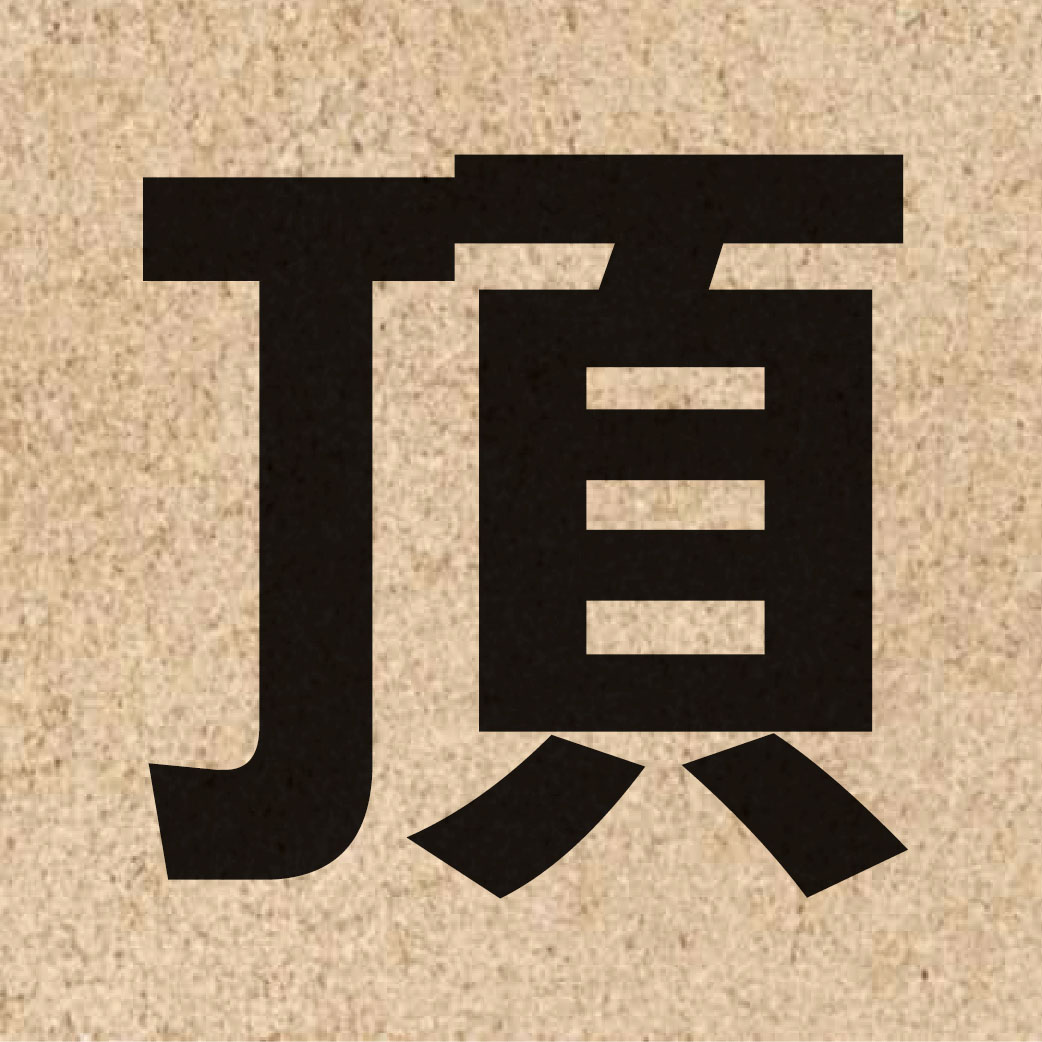
The Chinese character【頂】is used to describe a part or peak, and is mainly used for the following meanings:
The top or summit of the head. Explanation: (1) The uppermost part of the head. For example: “top of the head”. (2) The uppermost part of an object. For example: “roof”, “top of a building”, “top of a mountain”. (3) To disobey or offend. Such as: “talk back”, “contradict”. (4) Replacement or substitution. Such as: “replace”, “take over the name”, “take over the vacancy”. (5) Most, extremely. For example: “at most”, “best”. (6) Support and support. For example: “Hold the door, don’t let him in.”, “I’ll hold this matter, you don’t have to be afraid.” (7) Equal to, equivalent to. For example: “He can do the work of two people.” (8) To support with one’s head. For example: “standing tall and straight”, “wearing a straw hat on the head”. (9) Assumption or transfer of property. For example: “Take over a store.” (10) Quantifier. A unit used to count hats, sedan chairs, etc. For example: “a straw hat”, “two bamboo hats”.
You can refer to this for the pronunciation of the mentioned Chinese character.
Mandarin Pinyin of 【頂】:dǐng
Cantonese Jyutping of 【頂】:ding2/deng2
Here’s a brief introduction to the basic aspects of the character 【頂】︰
Here are some situations where you can use【頂】, for example:Describe the part or peak , It means mainly the top of the head or the top. .Chinese characters possess deep and diverse meanings, and some detailed aspects may not be entirely covered in this discussion.
【頂】is a fundamental term that integrates with others to create meaningful expressions, such as【山頂、屋頂】(Mandarin Pinyin:shān dǐng 、wū dǐng/ Cantonese Jyutping:saan1 ding2 、nguk1 ding2)
The number of strokes required for this character is 11 ,It is a highly common and fundamental Chinese character that must be learned,Here’s a practical example using this character.:
他們在山頂欣賞美麗的日出景色。
They enjoyed the beautiful sunrise view at the top of the mountain.
I hope you appreciate the depth of the Chinese language and gain useful knowledge here. Explore the information at your own pace.