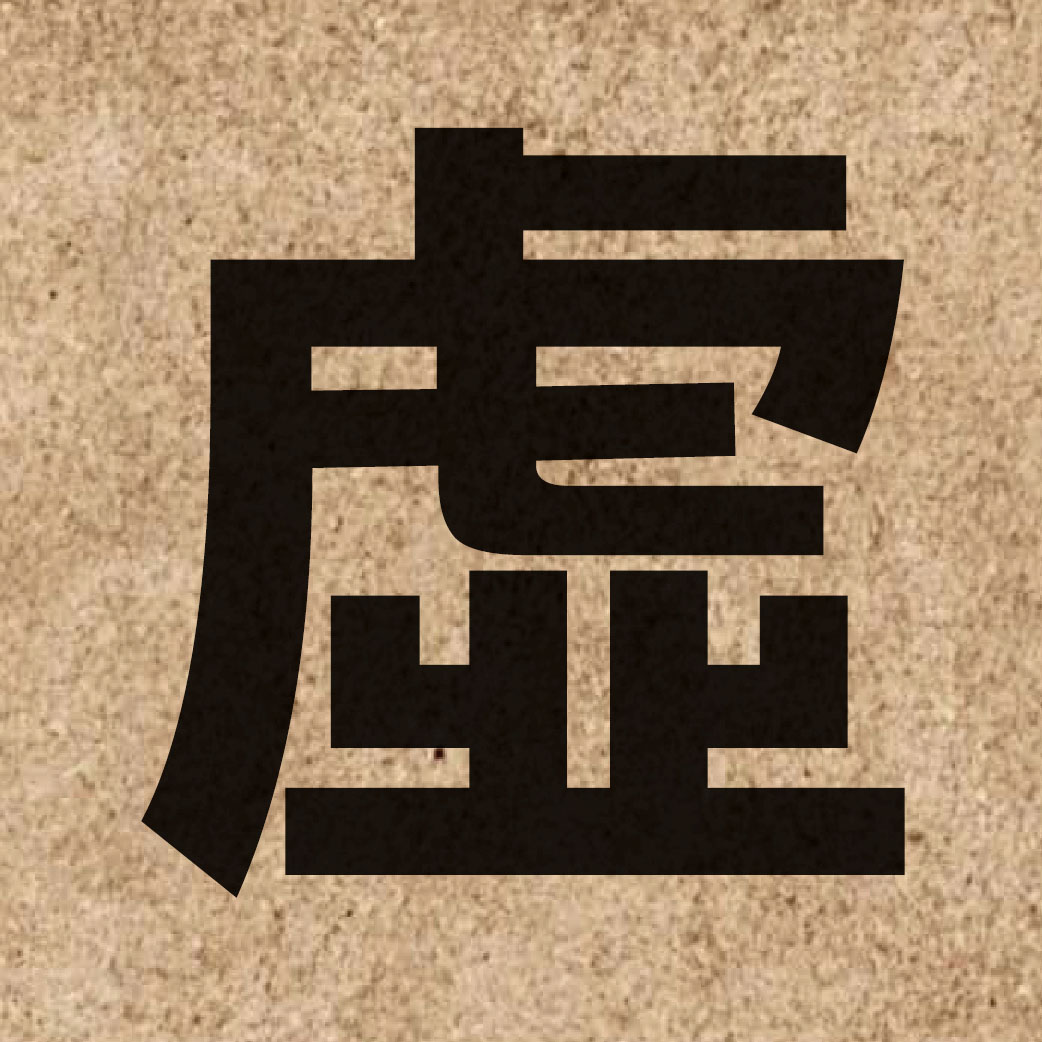
The Chinese character【虛】that I will teach you this time is a word that describes a state or feeling. It is mainly used for the following meanings:
Empty or false. Explanation: (1) False or untrue. Such as: “hypocrisy”, “false”, “fictitious”, “illusion”. (2) Weakness. For example: “weak”, “exhausted”, “her body is very weak.” (3) In vain, in vain. Such as: “waste time”, “the trip was worthwhile”, “all show and no substance”. (4) Do not be complacent or proud. Such as: “modest”, “seek advice with an open mind”. (5) Feeling guilty and timid. Such as: “guilty conscience”. (6) Empty. Such as: “emptiness”, “take advantage of the opportunity”. (7) Careless and perfunctory. For example: “To respond to a story in vain.”
You can refer to this for the pronunciation of the mentioned Chinese character.
Mandarin Pinyin of 【虛】:xū
Cantonese Jyutping of 【虛】:heoi1
This provides fundamental insights into the meaning of the character 【虛】︰
Here are some situations where you can use【虛】, for example:Describing a state or feeling , It means mainly emptiness or falsehood.The nuanced nature of Chinese characters means that some complex or precise interpretations may not be comprehensively conveyed in this space.
【虛】appears simple on its own, but when linked to other words, it creates nuanced phrases, like【虛心、虛弱】(Mandarin Pinyin:xū xīn 、xū ruò/ Cantonese Jyutping:heoi1 sam1 、heoi1 joek6)
This character consists of 12 individual strokes,It is a more advanced Chinese character that is essential for daily use,This sentence highlights one way to use this character.:
他以虛心的態度接受了建議。
He accepted the advice with an open mind.
May you find joy in studying Chinese and uncover valuable knowledge along the way. Feel free to take a slow and thoughtful look at the resources here.