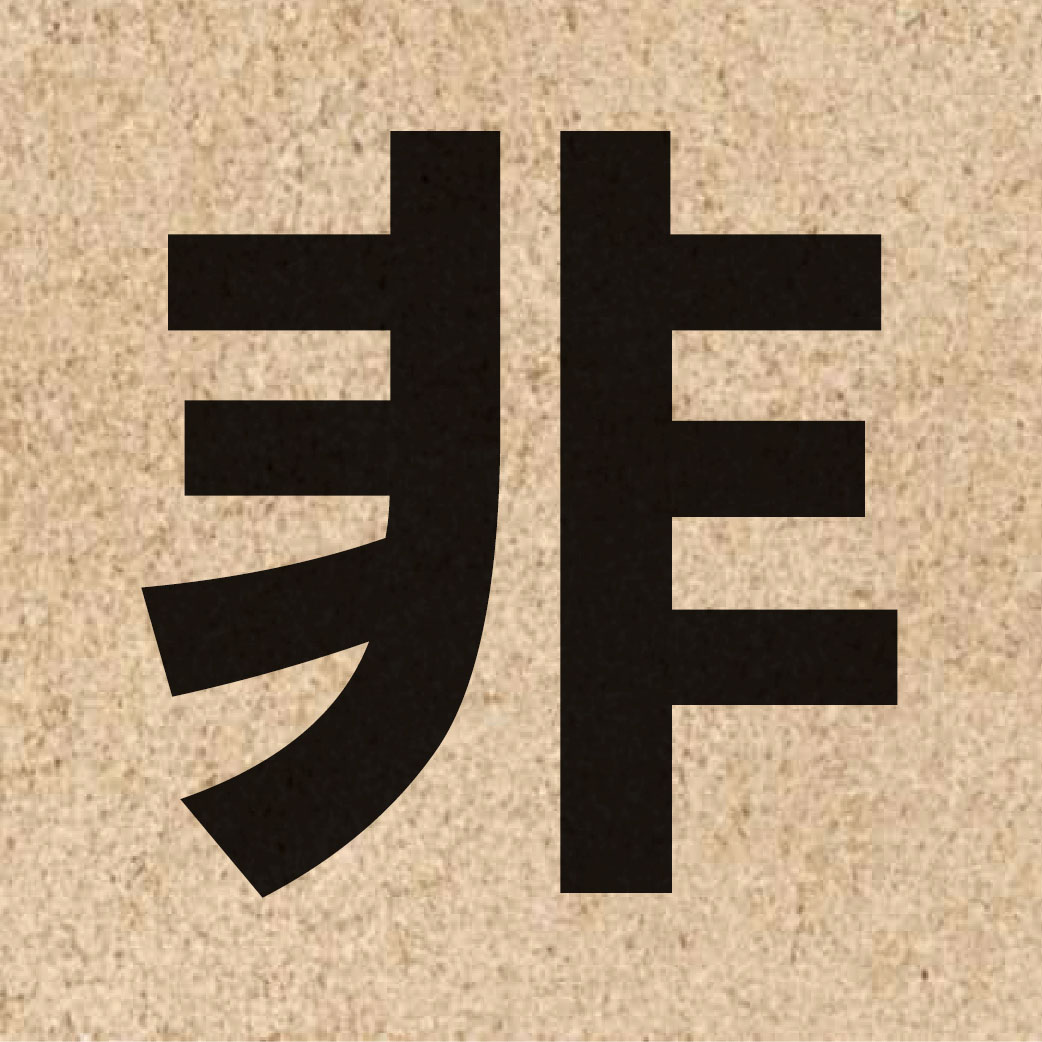
The Chinese character【非】is a word that describes a state or behavior, and is mainly used for the following meanings:
Negative or incorrect. Explanation: (1) No. Such as: “Not for sale”, “Not related or friend”, “Not answering the question”. (2) Mistake or fault. Such as: “right and wrong”. (3) Unwholesome. For example: “to do evil.” (4) Consider it wrong. Such as: “criticism”, “condemnation”. (5) Incompatible with. Such as: “illegal”, “do not look at what is inappropriate”. (6) Used with “不” and “莫” to express a must or certainty. For example: “I have to go”, “He is the only one.” (7) The abbreviation for Africa. (8) Feifei: bizarre, unrealistic fantasy. Such as: “wandering into wild thoughts”.
This is how you pronounce the given Chinese character.
Mandarin Pinyin of 【非】:fēi
Cantonese Jyutping of 【非】:fei1
Below is an introduction to the basics of the Chinese character 【非】︰
Here are some situations where you can use【非】, for example:Describes a state or behavior , It means mainly negation or inaccuracy. .The vast and layered meanings of Chinese characters can involve refined details and particular applications that may not be completely conveyed here.
【非】functions as a standalone word but can pair with others to form more descriptive expressions, like【非常、非法】(Mandarin Pinyin:fēi cháng 、fēi fǎ/ Cantonese Jyutping:fei1 soeng4 、fei1 faat3)
The stroke count for this character is 8 ,It is a highly common and fundamental Chinese character that must be learned,Here’s a sample sentence featuring this character.:
他的行為被認為是非法的。
His actions were considered illegal.
I trust you’ll enjoy immersing yourself in the world of Chinese and discovering more insights. You can browse through the additional details at your own speed.